Ibn Khaldun and the Canon of Political Thinkers
Published as a LinkedIn article and an SSRN Working Paper (and also on the Archipelago Wiki).
1. Introduction
Each August, in view of the academic slowdown, I undertake what I perceive as a challenging, in terms of its requiring peace of mind impossible to reach throughout the year, reading project: a couple of years back it was reading Kantorowicz’s The King’s Two Bodies[1]; last year it was (re-)reading all of Nietzsche (not Zarathustra, though). This August it was Ibn Khaldun’s The Muqaddimah.[2]
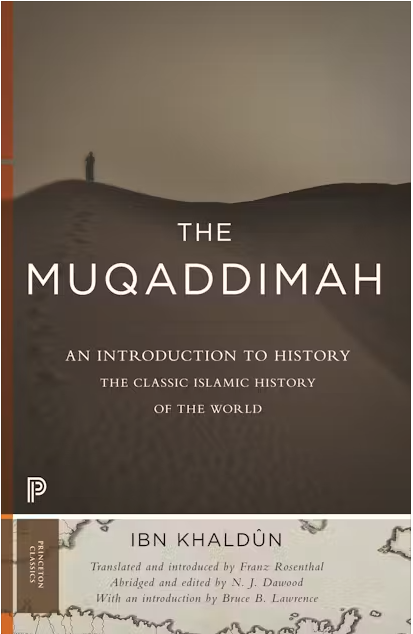
The Muqaddimah came as a surprise-recommendation to me. Normally for my August project I go either for recommendations made by friends over the past year (Kantorowicz) or follow my own wish to revisit past reading (Nietzsche). However, this year I took the unprecedented step to ask for a recommendation for my August reading project (therefore, a bit of brainstorming was needed) from ChatGPT, after discussing and clarifying a few of my Archipelago ideas with it.[3] There is a reason I am digressing—other than proper attribution, that is: the recommendation struck me first as an AI hallucination: Of Ibn Khaldun I had never heard anything ever before, so I failed to see the connection (the second recommendation was Gibbon, so this was explainable and familiar territory). To make things worse, and this is the actual reason for the digression, when I checked out The Muqaddimah, I saw that it was classified by the publisher under its ‘Middle Eastern Studies – Ancient History – Religion’ subject headings. Further, on the actual cover it reads (but not the book’s subtitle) ‘The Classic Islamic History of the World’. All that is well, but why on earth would this book relate to me specifically?
I was in for a serious surprise. After two relatively short introductions, mostly focusing on the book’s translation and providing context in terms of the life of its author, the actual text kicks in, where, however, the author himself spends many pages clarifying the aims and purposes of his work and the ways it differs from the work of his colleagues. It was therefore only 100 pages down the road, in Chapter 1, first prefatory discussion (on p. 45, where I recommend anyone to start the book from), that it really hit me: The Muqaddimah may be the classic Islamic history of the world but its author, Ibn Khaldun, belongs to the (well, at least, my) Canon of Political Thinkers.
2. My Canon of Political Thinkers
There is no formal, generally agreed-upon, canon of political thinkers. I have therefore applied my own rule: in order for any author to enter it, he (or, in the future, she) needs to (1) be a political thinker, i.e. have thought specifically about the polis, meaning the state, (2) have said something new, have brought forward a new idea, and (3) have introduced a system, i.e. an interconnected and coherent whole that, expanding that novel idea, can be used to explain political organisations before and after him.
Therefore, until recently, I started with Plato and Aristotle, touched lightly on Cicero (a great systematiser) and St. Augustine (a great religious thinker), and then, through a 1,000-year jump, I went directly to Machiavelli. After Machiavelli came Hobbes, with whom modernity started.
I am well aware that this canon is highly personal and can (and will) raise several eyebrows. For example, Thucydides is important but he is not on the list, because he did not think about the polis. To complicate things, academic curricula and book series on political philosophy are far more extensive and comprehensive—to the point, however, that one would need several lifetimes only to read the works included in them.
3. Ibn Khaldun’s The Muqaddimah
Ibn Khaldun, an Arab jurist and scholar, wrote The Muqaddimah (or, the Prolegomena) in 1377 while in retreat at Qalʿat Ibn Salama, in present-day Algeria. He did not aim to write a work of political thought: in fact, he specifically warns against it: ‘It is also not politics, because politics is concerned with the administration of home or city in accordance with ethical and philosophical requirements, for the purpose of directing the mass toward a behaviour that will result in the preservation and permanence of the species’ (39).
On the contrary, Khaldun aimed to write a work of history, indeed a universal history. His work is a multi-volume one, the Kitab al-ʿIbar, of which The Muqaddimah is only the introduction (whose initial draft was written in five months).[4] It is, however, exactly this introduction that has attracted the most attention and is still read independently today, including in the Princeton edition above.
The Muqaddimah was translated completely into English by Franz Rosenthal in 1958, and it is his translation that remains the standard English reference point today. Long before then Ibn Khaldun had already attracted Western scholarly attention, but largely within Oriental and historical studies (as the Princeton University Press classification ‘Middle Eastern Studies – Ancient History – Religion’ still suggests). Historians famously hailed the work: Arnold J. Toynbee called it ‘the greatest work of its kind that has ever yet been created by any mind in any time or place’.[5] Non-historians followed: Ibn Khaldun has been called, depending on the point of view, an early Machiavelli, Vico, or even Adam Smith.[6]
Importantly for this note, Cambridge University Press recently (in 2025) included him in its influential Cambridge Texts in the History of Political Thought series. Therefore, Khaldun’s place as a political thinker is secured—even if in a series of more than a hundred books, whose circle keeps expanding with each passing year.[7]
With all of the above I take issue from two angles: First, I really do not understand why anyone would try to identify affiliations between any two completely unrelated thinkers (such as in this case Khaldun and Adam Smith or Machiavelli), especially given that, as everybody knows, all that we have ever said and thought is simply a footnote to Plato anyway.[8] Second, Khaldun is no-one’s precursor or intellectual relative or explainer: he is an original, systematic political thinker in his own right.
The 2025 Cambridge volume goes further and presents Khaldun principally as a theorist of the state. In Gabriel Martinez-Gros’s General Introduction, the state is programmatically reduced to ‘taxation’ and reconstructed through the opposition between sedentary, productive populations and armed Bedouin minorities.[9] I am not persuaded by that route. At most, this seems to me a powerful account of one family of agrarian empires, not a portable theory of the state. Khaldun’s canonical contribution lies elsewhere: in government, and specifically in asabiyyah.
4. Why should Ibn Khaldun enter the canon of political thinkers?
Each political thinker is a product of his time (a tautology, but still one that needs to be highlighted). They all think about the polis in terms of an important issue of their time, and (hopefully) come up with a unique idea, and an underlying system, while treating it (i.e., understanding it, and offering a normative solution towards the summum bonum). Plato saw how a democracy can commit murder; Aristotle dealt with the first King, turned world-emperor, over otherwise independent Greek city-states; Cicero saw the rise of Rome and St Augustine its decline and the rise of Christianity; Machiavelli saw small, independent polities crushed under imperial and religious antagonisms; and Hobbes dealt with civil war, including a King’s formal execution by his own people.
What was the issue that Khaldun was faced with? Specifically, political order amid Arab and Islamic conquest, and dynastic state-building. His claim to novelty concerns the science through which he sought to explain these processes (39). His world was not composed of established, territorial states (Athens, Macedonia, Rome, Persia, India, China) that had already developed bureaucracies and administrations and were perhaps faced with serious crises but whose existence was obvious and well accounted for and documented.
His world, where he lived and worked, was composed of states that came into existence only a few hundred years before him, out of desert tribes that came together under a new religion and conquered large parts of the known world—importantly, establishing themselves in them.
In other words, Khaldun’s problem was not that of a fixed population and territory awaiting a government. He had to explain how a group acquired the cohesion to establish and sustain a government (in the form of royal authority) beyond its place of origin.
In order to do so, he suggested nothing less than an alternative to the Social Contract theory: Asabiyyah.
4.1 Khaldun’s political thinking: government formation and political legitimacy
Although Khaldun set out to write a universal history, he saw early enough that the part of the world he sought to examine was fundamentally different from the world around it that it had partially replaced, meaning that of the Persians or Byzantines with whom the Arabs fought (and who form the counter-example throughout his work). Therefore, in spite of his warning above, he opens his work (Chapter 1, first prefatory discussion) discussing things from the start: ‘Human social organization is something necessary. The philosophers expressed this fact by saying: “Man is ‘political’ by nature.” That is, he cannot do without the social organization for which the philosophers use the technical term “town” (polis)’ (45).
A political theory, therefore, underlies Khaldun’s work. This is a far from obvious choice: Any historian who sets out to write a history (Thucydides included!) does not need to outline first his political theory—he or she can simply take the polities for granted and start discussing the facts—it is not, after all, his or her work to provide a theory of how the world as we know it came to be. Khaldun differs, and therefore needs to be treated (also) as a political thinker.
What is Khaldun’s political theory? The account here can only be brief: Human social organisation, which means civilisation (35), is necessary. However, humans are aggressive and unjust by nature (47) and ‘are prone to seek superiority and domination’ (293). A ‘restraining influence’ is thus needed, that must be exercised by another human (no third party can do it) (47). The government (‘royal authority’) is therefore ‘a natural quality of man which is absolutely necessary to mankind’ (47), the ‘result of an ability to think or to administrate’ unique to humans (47).
Therefore, ‘(People) in any social organization must have someone who exercises a restraining influence and rules them and to whom recourse may be had. His rule over them is sometimes based upon a divinely revealed religious law. They are obliged to submit to it in view of their belief in reward and punishment in the other world. Sometimes, (his rule is based) upon rational politics. People are obliged to submit to it in view of the reward they expect from the ruler after he has become acquainted with what is good for them’ (257).
Khaldun’s focus is on government. He is less concerned with separating an enduring state from whichever government happens to hold it, because the political world he describes often did not present that distinction cleanly: dynasties rose, conquered, expanded, contracted and sometimes carried the effective political unit with them. He was immensely interested in government: how such a government (a dynasty or ‘royal authority’) was formed in the first place, how it acquired a claim to rule, and how it established itself thereafter.
It is exactly there, in the formation and political legitimacy of government and in its subsequent establishment of political order, that Khaldun develops asabiyyah into a political concept.
4.2 Khaldun’s original idea: Asabiyyah (‘group feeling’)—no ‘Social Contract’
Khaldun felt he had to explain Arab states, if he was to write their history. These states were formed by desert tribes that banded together, conquered settled states and then established themselves within them. A government was needed for this move: a government that moved away from home, conquered, and then established a new political order. Once established, administrative devices such as the diwans or registers helped make that new polity governable (which is the connection I was looking for with the Archipelago ideas).[10] What gave such a government its political title, first within the conquering group and then as an established ruling authority? Khaldun’s explanation was asabiyyah (‘group feeling’).
Khaldun approaches and explains asabiyyah through its functions: Group feeling ‘enables him [a person in authority] to force the others to follow him wherever he wants to go’ (47); it ‘produces the ability to defend oneself, to offer opposition, to protect oneself, and to press one’s claims’ (111); its purpose is ‘defence and aggression’ (148); its power is ‘one of the natural powers’ (128); or ‘behind each opinion and desire, there is a group feeling defending it’ (130). Basically, ‘group feeling is something composite that results from (amalgamating) many groups, one of which is stronger than all the others’ (132).
Asabiyyah’s aim is royal authority (government): ‘Royal authority is the natural goal of group feeling. It results from group feeling, not by choice but through (inherent) necessity and the order of existence’ (160). For its part, royal authority ‘belongs only to those who dominate subjects, collect taxes, send out (military) expeditions, protect the frontier regions, and have no one over them who is stronger than they’ (152). The nature of royal authority ‘requires that one person claim all the glory for himself and appropriate it to himself’ (164). Government being therefore an institution that is natural to mankind (151), asabiyyah is ‘absolutely necessary’ to its foundation (152): ‘A dynasty can be founded and established only with the help of group feeling. There must be a major group feeling uniting all the group feelings subordinate to it’ (246). In describing dynastic decline, Khaldun writes that ‘group feeling has often disappeared (when the dynasty has grown senile), and pomp has taken the place it occupied in the souls of men’ (246). Finally, ‘when the group feeling is lost and replaced by another group feeling, a great disintegration sets in’ (291).
Importantly, asabiyyah can be improved and cultivated. Chapter 3 of The Muqaddimah reads like a government manual, and this helps explain the comparisons with Machiavelli, who likewise provides a government manual in The Prince (thus, like Khaldun, enabling the development of a theory of the state without separately articulating one).
As such, Khaldun deals with the fundamental political issue of governmental legitimacy. By legitimacy I mean here not a moral entitlement of the ruler that creates an individual duty to obey, but the political basis on which one person’s claim to govern becomes the recognised claim of a group and can found an enduring authority. Given that someone has to rule (humans are social animals), who will that be? Over the centuries a number of answers have been proposed: the one appointed by God; the one elected by the many; the noble few; aristocrats; those selected by merit. Social Contract theory answers through agreement or authorisation. Khaldun’s answer is different: a claim to government becomes politically real when it is sustained by asabiyyah. His political world did not allow him simply to assume a stable territorial connection between an already constituted population and its government; he had to explain the bond between the group that moved, conquered and governed and the authority that emerged from it.
Importantly and crucially, that ‘group feeling’ was not Arab-specific and was not confined strictly to blood kinship. Khaldun expressly extends its operation to ‘clients and allies’ (98), allowing the bond to reach beyond the original tribal core, without necessarily encompassing everyone under the ruler’s authority. What matters is the effective bond, rather than remote pedigree: knowledge of common descent becomes useless when it no longer generates the affection associated with group feeling (99).
In this way asabiyyah is only partially Savigny’s Volksgeist.[11] Asabiyyah falls primarily under government theory, not state (or nation) building theory. It explains the political basis of governmental authority more than the constitution of a territorially fixed state. In Khaldun’s world the distinction between state and government is often blurred precisely because the effective political unit could follow the dynasty that conquered and governed it. This is why asabiyyah can occupy a theoretical position later occupied, on very different premises, by the Social Contract: it supplies the bridge from plurality to a particular government, not through rational agreement (the Social Contract theory already suggested by Plato, but formally introduced, thus opening up modernity, by Hobbes) but through an effective collective bond.[12]
4.3 Khaldun’s system
Khaldun thinks in terms of cycles. Once he identifies the basic components of his political system (tribes, sedentary people, governments, asabiyyah) and an initial starting point (‘Bedouins are prior to sedentary people. The desert is the basis and reservoir of civilization and cities’, 93), he then cycles them broadly along the following lines: Bedouins (hard, desert warriors) conquer sedentary people (established, civilised and luxurious states), because they are hardened by difficult life conditions and thus can militarily overcome sedentary, civilised states uninterested in conflict. However, conquerors quickly become accustomed to their newly acquired civilised and sedentary life and they themselves become prey to new, hardened warriors that come from other places (134–138).
Similarly, governments (dynasties) follow a cyclical trajectory (141–142): At first their asabiyyah is strong (focused around a leader who is necessarily fair to those who helped him ascend), then the leader solidifies his position and eradicates competition—and becomes unfair in the process, then a competitor who promises to amend all these evils emerges, develops his own asabiyyah, and eventually wins and replaces the former government—to subsequently follow exactly in its steps.
Interconnections, as seen, are robust: Asabiyyah is born, connects many, aims at royal authority (government) that remains sovereign, is assisted by religious or other narratives, wins and establishes itself—or loses or decays and is replaced by another.
Other sub-systems underlie and support his philosophy, such as the centre-periphery distinction (centres are not permanent, but once established it is they that hold the whole together, 128–129, 290), or that there are limits to expansion, be it in territory controlled by dynasties (128) or in cities (in chapter 4), beyond which decay begins. He also repeatedly understands political change through generational succession (105–107, 136–138).
Other finds are relevant and interesting too: Khaldun gives us an account of the noble savage (on p. 94, an idea found in Plato well before Rousseau)[13], or that ‘fairness means justice’ (114) or his description of the Bedouins’ ‘freedom from authority and no subservience to leadership’ as a disposition that is ‘the negation and antithesis of civilization’ (118).
His methodological tools are rational-Aristotelian: ‘Every event (or phenomenon), whether (it comes about in connection with some) essence or (as the result of) action, must inevitably possess a nature peculiar to its essence as well as to the accidental conditions that may attach themselves to it’ (36), so they need to be examined with ‘the possibility inherent in the matter that belongs to a given thing’ in mind (146). Government and sovereignty (dynasty and royal authority) ‘have the same relationship to civilization as form has to matter. (The form) is the shape that preserves the existence of (matter) through the kind (of phenomenon) it represents’ (291).
Khaldun remains clear-headed throughout his work, in spite of his (religious and dynastic) environment. We saw already that he distinguished between God and rationality as regards government legitimacy; the same clear-headedness applies, for example, to explaining differences among the people around him: ‘It should be known that differences of condition among people are the result of the different ways in which they make their living’ (91), or group membership (‘the only meaning of belonging to one or another group is that one is subject to its laws and conditions, as if one had come into close contact with it’, 101) or the reinforcing role of religious fanaticism when it comes to military operations (126).
5. Conclusion
As said, to enter the Canon a political thinker has to remain current at all times: his or her system, based on an original idea on the polis, needs to apply throughout human history. I think that Khaldun qualifies. The Muqaddimah can readily and effortlessly be read at any time as a relevant and useful governance manual. The cyclical system is also applicable: although conquerors from the desert cannot be plausibly expected today, cycles in politics correspond neatly with government change in the short term—and perhaps state succession in the long one.
At a subtler level, I think that Khaldun wins his place in (my own, at least) Canon of Political Thinkers because of his asabiyyah. Specifically, Khaldun’s importance lies in the account of governmental legitimacy that he offers as an alternative to the Social Contract.
Legitimacy is the main, current problem of state theory: state formation at the end of the day is a matter of fact; an inquiry into governmental legitimacy can take the existence of the state as its starting point. It is legitimacy that always has been, and remains, the burning issue for all humans: if a government is necessary, how is it chosen and on what political basis can its authority be understood as belonging to a group?
Today the Social Contract theory (meaning, theorised rational agreement) remains dominant. Khaldun provides an alternative: asabiyyah, or ‘group feeling’, can legitimate a government.
Asabiyyah need not take the form of an explicit agreement. Shared narratives, including myths of common origin or destiny, may cultivate it; its political significance, however, lies in the effective bond through which a group supports and sustains its government. It therefore offers a perspective on government that cannot be reduced to theorised rational agreement. As such, meaning as an alternative to rationalisation and Social Contract theory, it provides us with an always-present and relevant angle from which to explain, and understand, politics.
[1] Ernst H. Kantorowicz, The King’s Two Bodies: A Study in Mediaeval Political Theology (Princeton University Press, 1957).
[2] Ibn Khaldûn, The Muqaddimah: An Introduction to History, translated and introduced by Franz Rosenthal, abridged and edited by N. J. Dawood, with an introduction by Bruce B. Lawrence (Princeton Classics, Princeton University Press, 2015). Unless otherwise indicated, page numbers in parentheses refer to the printed-page numbering reproduced in this abridged edition, not to the pagination of Rosenthal’s complete three-volume translation (1958). The abridgement was first published in 1967; Lawrence’s introduction dates from 2005.
[3] Vagelis Papakonstantinou, Archipelago, and the information platform that is the state: A political philosophy based on information and its processing (Nomos, 2026).
[4] Ibn Khaldûn, Muqaddimah, 459: the concluding statement dates completion of the draft, before revision and correction, to November 1377. For the biographical setting, see Gabriel Martinez-Gros, ‘General Introduction’, in Ibn Khaldūn: Political Thought, edited by Gabriel Martinez-Gros, translated by Anna Bailey Galietti (Cambridge University Press, 2025), xv–xviii.
[5] Arnold J. Toynbee, A Study of History, vol. III, The Growths of Civilizations, 2nd ed. (Oxford University Press, 1935), 322, as quoted in Bruce B. Lawrence’s introduction to the Muqaddimah, viii and n. 4; also reproduced in Rosenthal’s introduction, xxxv and n. 13. The wording here follows that reproduced in the edition used for this note.
[6] For examples of such comparisons, see Rosenthal’s introduction to the Muqaddimah, xxxv n. 11 (Vico); Martinez-Gros, ‘General Introduction’, xlv (Machiavelli); and Christian Fuchs, ‘Ibn Khaldûn and the Political Economy of Communication: A Reply to Graham Murdock’ (2024) 50(4–5) Critical Sociology 757–765, section ‘The state and neoliberalism’, DOI: 10.1177/08969205231201382 (reporting and disputing Murdock’s comparison with Adam Smith).
[7] Ibn Khaldūn: Political Thought, edited by Gabriel Martinez-Gros, translated by Anna Bailey Galietti, Cambridge Texts in the History of Political Thought (Cambridge University Press, 2025), DOI: 10.1017/9781009328760. The series catalogue listed 125 books when consulted on 29 September 2026, including announced titles; this is not a count of distinct authors.
[8] As said by Alfred North Whitehead, Process and Reality: An Essay in Cosmology (1929), corrected edition edited by David Ray Griffin and Donald W. Sherburne (Free Press, 1978), 39.
[9] Martinez-Gros, ‘General Introduction’, xx–xxix, especially xx: ‘The state can be reduced to a single word: taxation.’ He expressly treats ‘Bedouin’ and ‘sedentary’ as political categories, not merely geographical or occupational ones: see also the Glossary, x–xii, and the generalisation at xxix. DOI: 10.1017/9781009328760.002.
[10] Ibn Khaldûn, Muqaddimah, 198–200, on the fiscal office, the military roll and the dīwān as both a register and an administrative office. The passage supports the administrative role of registers; it does not describe a universal register of every inhabitant.
[11] Compare Friedrich Carl von Savigny, Of the Vocation of Our Age for Legislation and Jurisprudence, translated by Abraham Hayward (Littlewood & Co., 1831; German original 1814), §2, 18–24, on law, language, popular conviction and the people’s common consciousness.
[12] For ancient contractual arguments, see Plato, Crito, 50a–54d, especially 51d–52d; also Republic, II, 358e–359b. For Hobbes’s systematic account, see Leviathan (1651), part II, chapters XVII–XVIII and XX.
[13] Compare Plato, Laws, III, 678e–679e, on the relative simplicity and virtues of early communities.