Archipelago, and the information platform that is the state
A political philosophy based on information and its processing

This book outlines a new political philosophy that is based on information and its processing.
Aristotelians will appreciate the analysis; those siding with Plato (there are only two kinds of people, as Coleridge said), less so. In essence, it supports Aristotle’s argument by complementing his intuitively correct but unsupported and never fully elaborated claim that states are natural to humans. It corrects Plato and his epigones (practically every political philosopher ever since) by refuting their claim (considered a given today) that states are artificial, the product of agreement among humans.
It is based on only two basic, and straightforward, premises. Therefore, understanding it (but not necessarily appreciating it—for that one has to follow the order of things) can be achieved in anything from a few minutes (see only Chapters 7 and 19) to a few hours (add Chapters 8, 9 and 11), a few days (Chapter 7 onwards) or a few months and beyond (read also Chapters 1–6). Each chapter is independently written specifically for this purpose, and therefore, there is some repetition. Notes (only paragraphs marked with an asterisk are annotated, at the end of the book) are there to help explain—but they do add considerably to the times just promised.
Companion material
How to read this book. Archipelago is structured in two layers: the Corpus is the main text, while the Notes provide further discussion and bibliographical references only for paragraphs marked with an asterisk. A one-slide reading guide is available here.
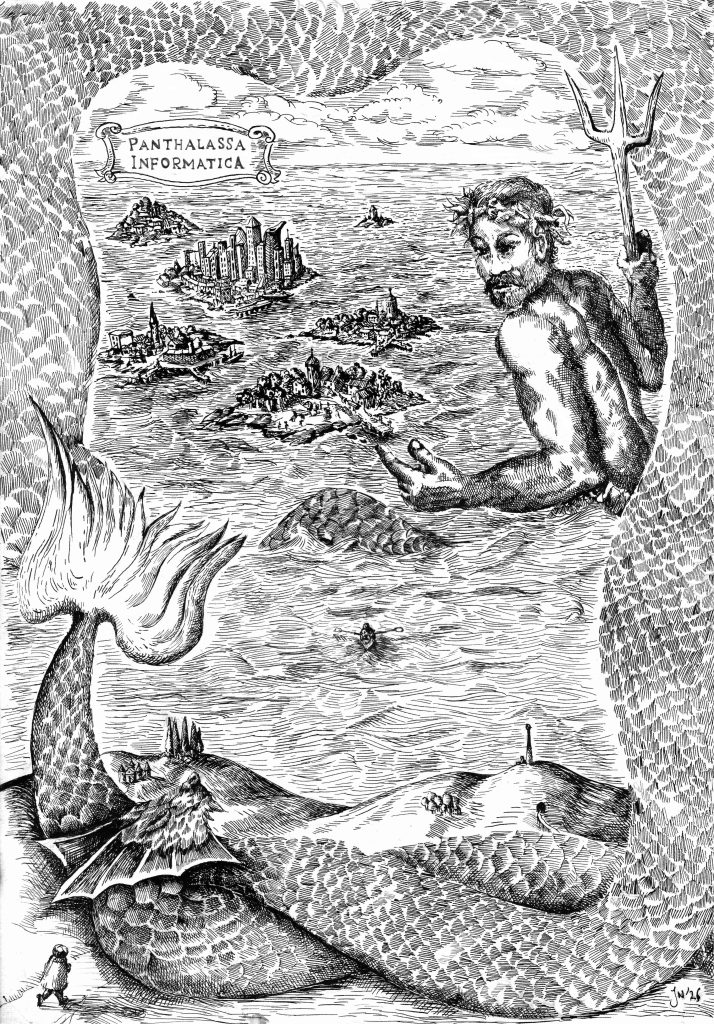
Frontispiece. The frontispiece to Archipelago was created by James Nunn. More information on it can be found here.
Note. This page gathers companion material related to Archipelago, and the information platform that is the state. The book itself is the authoritative statement of the argument. Earlier essays, posts, and talks listed below document the development of the project and should be read in that light where they diverge from the final text.
Key essays
- [Chapter] States as information platforms: A political theory of information — In Data protection and privacy: Ideas that drive our digital world, 2024. (An early formulation of the argument subsequently developed and revised in Archipelago (2026). The book represents the author's current position.)
- [Article] States as platforms following the EU regulations on online platforms — European View, 2022.
All other essays & chapters (full list)
-
- [Chapter] Digital constitutionalism in the states-as-platforms context: A new programme, the acknowledgement of 'platform rights' — In Digital constitutionalism, 2025.
- [Article] The cybersecurity obligations of states perceived as platforms: Are current European national cybersecurity strategies enough? — ACIG, 2022.
Blog posts
- [Blog] The (new) role of states in a states-as-platform approach — January 2023.
- [Blog] States as platforms under new EU (online platforms') law — July 2022.
Talks & media
- [Talk] Novel concepts in digital states and their structures — CPDP2023, May 2023 (from 00:30).
- [Seminar slides] The State as Information Platform: Law, Political Philosophy and Digital Governance — Inaugural session of The Archipelago Seminar: Law, Information and the State, VUB, 21 May 2026.