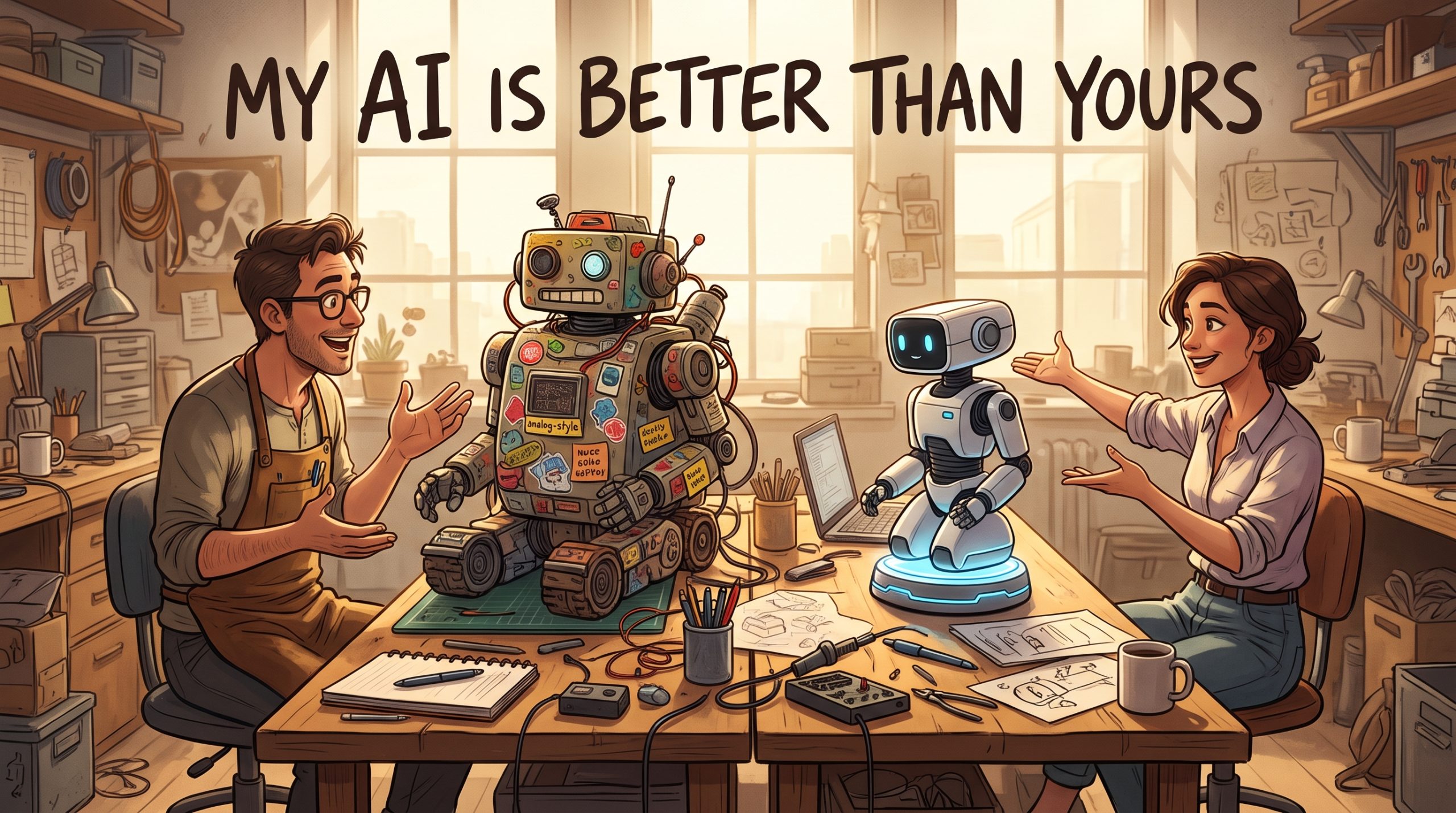
My AI is better than yours!
Published on LinkedIn, on 21 October 2026
The first to feel the wind of change were probably those receiving submissions of all kinds. Only a few weeks ago, for example, the European Commission announced that proposals for the Marie Skłodowska-Curie Postdoctoral Fellowships had more than tripled since 2022. In March, Springer Nature announced manuscript submissions had grown by more than 30% in 2025. Nor is this surge confined to science: a study of US federal courts found an increase of approximately 50% in non-prisoner civil cases involving self-represented litigants between 2023 and 2025, after excluding exceptional mass litigation (see also a Texas Supreme Court report). Artificial Intelligence (AI), I think, is the common denominator in all these examples: its generalized use has increased human output exponentially.
Then came reality: Practically any professional (doctors, lawyers, architects, accountants, etc.) increasingly faces AI-equipped clients who use it to interpret medical tests, amend contracts, design houses or develop tax strategies.
University classrooms were probably hit last: Universities across the globe are currently hopelessly looking for ways to revise their exam practices in response to students’ widespread use of AI and the possibility of cheating, sometimes reviving pen-and-paper examinations.
The phenomenon is now clear for anyone to see: AI has become part of everyday life, used relentlessly by each one of us in any aspect of our lives.
Which AI?
This is where things get tricky: everyone is using AI, but which AI are they using? AI comes in many offerings: basic use may be free, but regular use with a full range of add-ons can easily cost hundreds of euros per month.
The models differ, too. Some of us use general-purpose large language models; others choose specialised or open-source systems, configured and operated for their particular needs.
The way we use AI matters just as much. A recent Dropbox study proved what I believe we all do in practice: more than two-thirds of users of AI affect the final product themselves. This means in practice that most of us, whenever we wish to create anything, do make use of AI at various stages of drafting. However, we intervene before finalisation: we do not let AI have the final say on our output.
Crucially, AI models by now allow both memory and personalization. This in practice means that our AI learns and evolves with us, with each one of its individual users. This does not affect only the interface of our own communication with it (formal or informal etc.), but also its output: later output is informed by earlier output. Through that process, we develop a particular way of working together.
Consequently, even if everyone uses AI, the details matter. Which AI we choose and how each one of us uses it matter. In essence, choice and implementation and actual use demonstrate how and how much each one of us has included himself or herself in the process.
When, a few years ago, I argued for a right to AI individualisation, I had not imagined how concretely this would take shape: through the long hours spent working together, each of us is building his or her own AI.
The response so far
Humanity’s response to the AI onslaught has been one of stunned surprise. Receiving organisations publish figures that demonstrate the scale of the increase, while struggling to absorb it.
As might be expected, the practical response is reciprocal. Receiving organisations increasingly turn to AI to process the growing volume. AI-drafted replies answer AI-drafted inquiries about jobs, research proposals and applications. Professionals use AI to deal with AI-prepared requests, while reviewers use it to assess AI-assisted texts.
The basic recourse employed until now in all these cases is notification. Everyone is obliged to notify others that he or she is using AI in their output, be it text or image or sound. This is not much different to the first days of cars: someone with a red flag had to run in front of them.
In practice, then, we are pitting AI against AI, while continuously notifying one another that we are doing so.
The way forward: My AI is better than yours!
Rather than continue to do the obvious (each one of us notifying the other that both of us are using AI in our dealings) I think that what we need to do is, first, to tacitly acknowledge the fact, and, then, to come to realize that not all AI is the same. Enough time has passed since its introduction, and enough time has been spent working with it by each one of us, to individualise and customise it.
Simply put, my AI is better than yours. My own personal AI, used by me for hours each day, I think, is better (for these particular tasks, of course!) than an AI brought into my domain for the first time. That advantage comes from what I bring to our work together: my knowledge, standards, corrections and practice. The hours matter because of what we do with them.
Continuing my older parallel between AI and a hammer, I would say that my own hammer, shaped through months or years of trial and error, is better suited to my tasks and purposes.
This, I think, is an appropriate response to the AI-equipped client. For example, an architect working daily with AI brings something to the process that a client asking for a house design for the first time does not. The same applies to a reviewer whose AI-assisted work is guided by years of experience with articles, PhDs and postdoctoral research. Use of the same tool does not wipe out that difference.
Of course, at times equals will clash: an expert and his or her AI will face another expert and his or her AI. This is when personalization comes in: my AI, having worked hundreds of hours with me, knows how I think and helps me produce a particular type of output, as opposed to your AI, which has worked hundreds of hours with you and helps you create your own output.
Same with academic exams: resorting to pen-and-paper exams in 2026 feels to me like asking students to keep using typewriters after word processors had become available in the 1980s. A repetition of the past is never a solution. Students should be allowed to take exams using their AI to answer questions that their professors have prepared with their own AI. Students should also know that their answers will be marked by their professors using AI.
What about the law? I am myself plus my information
All this opens a discussion about my digital presence and personality, my digital persona. In essence, I am myself plus my information. This has always been true in the analogue world; the digital world has made it plainly visible.
If I am myself plus my information, what happens to my information? In Europe data protection law protects personal information. But what about continued access to my AI, as a personal creation and daily assistant? What happens if someone operates a ‘kill switch’—indeed, a non-European one, given that Europe is digitally colonised? What happens if new models or updates become unavailable to me for political reasons?
New legal tools may be needed to protect this part of my digital self. Cybersecurity, for example, could offer one way forward. The issue extends beyond the information held about me to the continuity of an assistant that I have helped shape.
Until then, we will keep working with our AIs, improving our work and making them increasingly our own. Perhaps there is something unavoidably anthropomorphic about this: human beings shape the tools with which they think and act. What makes my AI mine (and, I would argue, better for my work) is the knowledge, judgement and experience I have put into it.
***Notification: Of course this article has been drafted with the assistance of (my!) AI.****