Rowena Rodrigues

Rowena’s prior experience includes co-leading the oversight and operational management of a multi-disciplinary research and innovation team. Rowena has expertise and a keen interest in the impact, governance, and policy dimensions of new and emerging technologies, with a strong focus on artificial intelligence. She has over 10 years of experience with EU funding programmes and has led or contributed to a wide range of research initiatives over the past 15 years. She has worked closely with a diverse set of internal and external stakeholders across all organisational levels, including policymakers, funding bodies, researchers from various disciplines, industry representatives, standardization bodies, ethics committees, civil society organizations, and the media. Her work is grounded in a commitment to responsible innovation and the development of inclusive, forward-thinking technology governance.

Rowena’s work has spannned research and consultancy in law (including human rights), ethics and the societal impacts of new and emerging technologies. She has deep expertise in  impact assessment (covering privacy, legal, ethical, socio-economic dimensions), comparative legal analysis, privacy and data protection (law, policy and practice). Rowena has a PhD in law and an LLM in Innovation, Technology & Law from the University of Edinburgh.

Rowena is the co-author of Ethics of Artificial Intelligence: Case Studies and Options for Addressing Ethical Challenges and co-editor of Privacy and Data Protection SealsShe has published widely in leading journals and is well-cited in the areas of AIimpact assessment, and ethics in research & innovation.

loading images
LOADING IMAGES
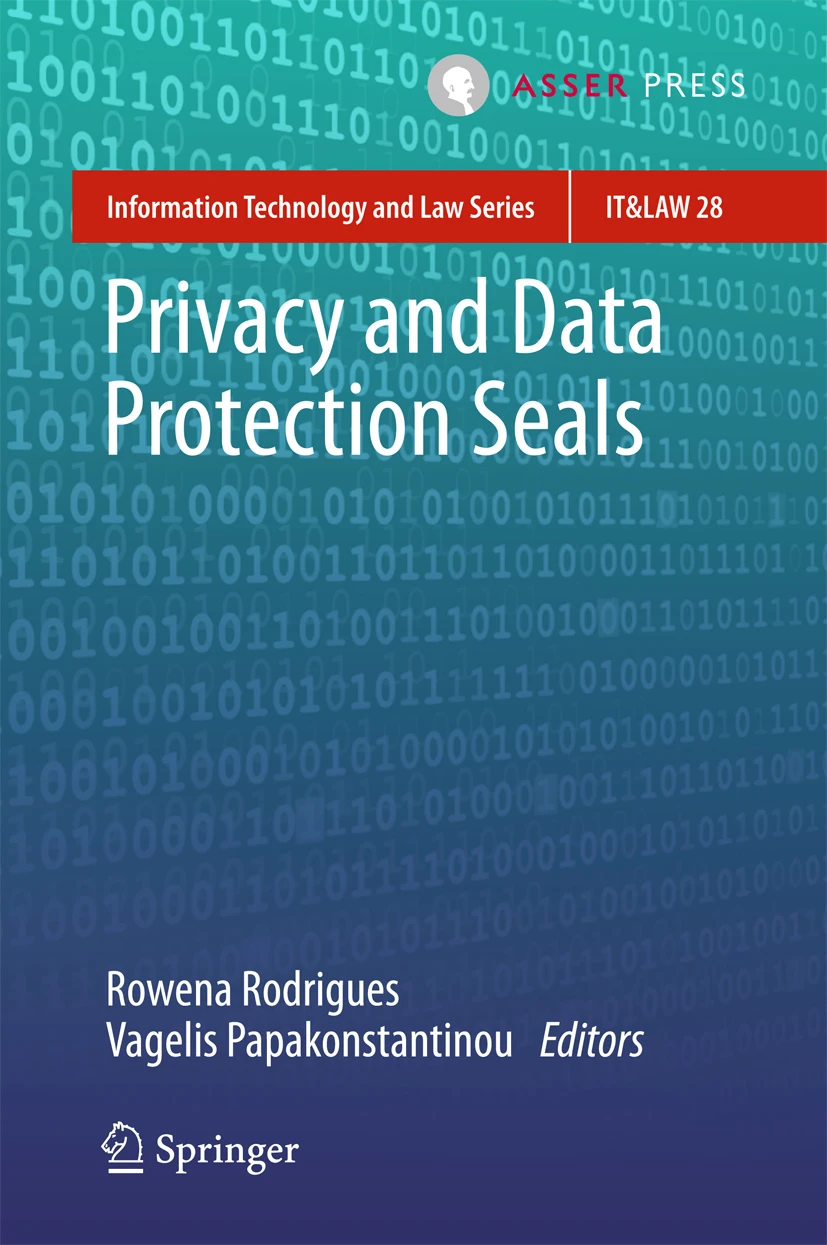
Book Cover: Privacy and Data Protection Seals

Editors: Rowena Rodrigues; Vagelis Papakonstantinou

The book presents timely and needed contributions on privacy and data protection seals as seen from general, legal, policy, economic, technological, and societal perspectives. It covers data protection certification in the EU (i.e., the possibilities, actors and building blocks); the Schleswig-Holstein Data Protection Seal; the French Privacy Seal Scheme; privacy seals in the USA, Europe, Japan, Canada, India and Australia; controversies, challenges and lessons for privacy seals; the potential for privacy seals in emerging technologies; and an economic analysis. This book is particularly relevant in the EU context, given the General Data Protection Regulation (GDPR) impetus to data protection certification mechanisms and the dedication of specific provisions to certification. Its coverage of practices in jurisdictions outside the EU also makes it relevant globally.

This book will appeal to European legislators and policy-makers, privacy and dataprotection practitioners, certification bodies, international organisations, and academics.